
ISSN 2579-2792
About the Journal
The international bilingual peer-reviewed scientific-methodological journal Education in the 21st Century has been published by Yerevan State University (YSU) since 2019. The journal's editorial and academic operations are managed by the YSU Pedagogy and Education Development Center. Issued biannually, the journal complies with international standards of publication ethics and rigorous peer review. The international editorial board consists of affiliated researchers and experts from domestic and foreign academic institutions. The journal serves as an academic forum for examining contemporary educational issues, disseminating research findings, and analyzing pedagogical models.
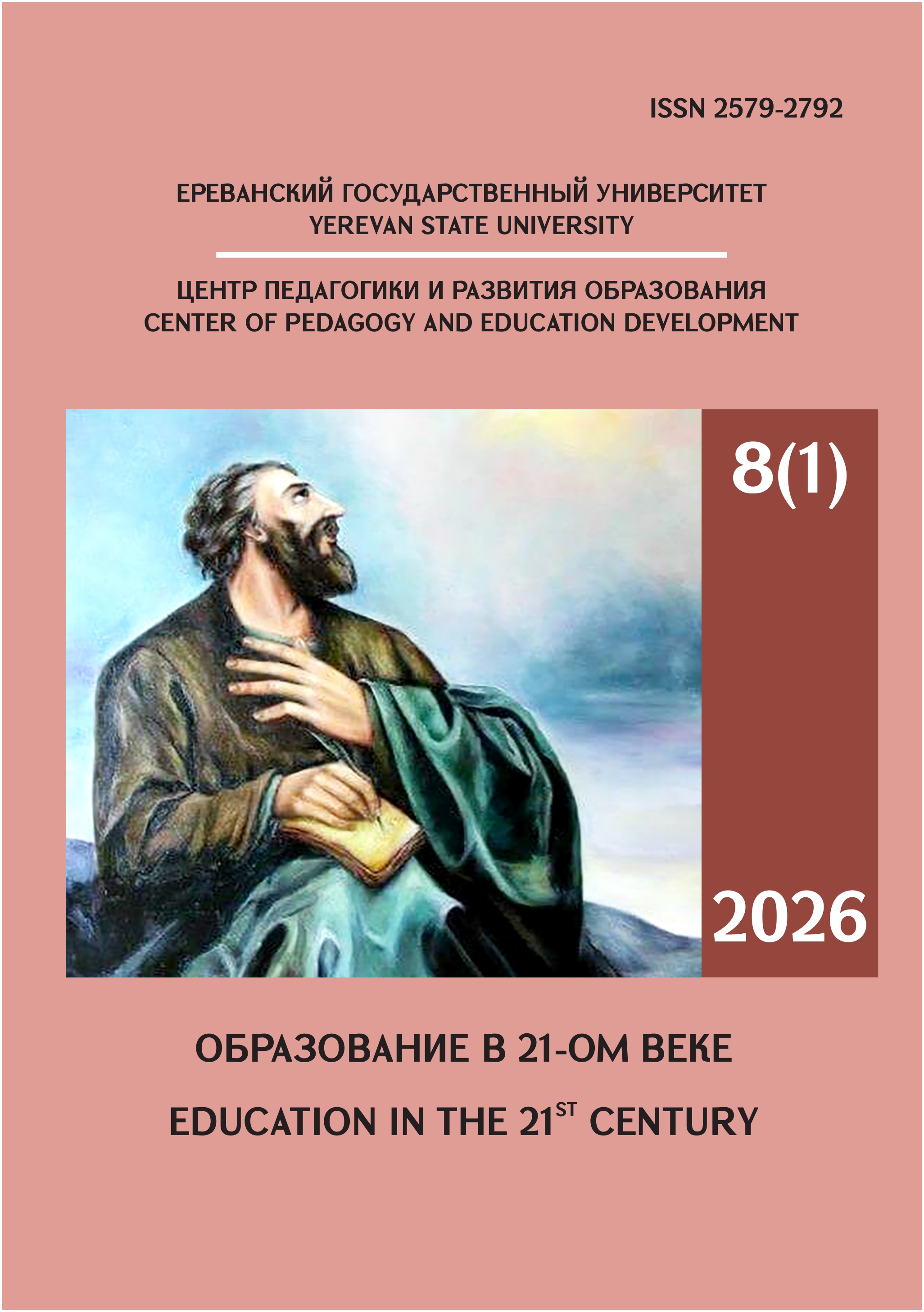
On the cover of this edition is the image of Mesrop Mashtots - an outstanding Armenian scientist-educator, the creator of Armenian Alphabet and the founder of the Armenian pedagogical tradition.
Current Issue
Vol. 8 No. 1 (2026): “EDUCATION IN THE 21ST CENTURY” INTERNATIONAL SCIENTIFIC-METHODICAL PEER-REVIEWED JOURNAL
Full Issue
THEORY AND HISTORY OF PEDAGOGY
-
THEORY AND HISTORY OF PEDAGOGY
EXISTENTIAL-PHENOMENOLOGICAL APPROACH TO THE TRANSFORMATION OF EDUCATIONAL CONTENT THROUGH THE ACTUALIZATION OF SCIENTIFIC HERITAGE: THE CASE OF O.M. TUTUNDZHYAN
AbstractThe article proposes a novel methodological lens for analyzing and consolidating three vectors of educational content transformation: the revival of historical-cultural traditions (reflexive engagement with classical texts), the implementation of current educational policies (incorporation of priorities and execution of regulatory documents), and the initiation of innovative projects (utilizing digital platforms). The existential-phenomenological theory of educational content (Bermus, Serikov, & Altynikova, 2021; Lednev, 1991; Shalygina & Shabalin, 2017) serves as the theoretical framework, founded on the morphosemantic analysis of the Russian word for content, soderzhanie (so-derzh-ani), and a five-level model (ranging from pre-conceptual experience to multicultural dialogue). Using the example of O. M. Tutundzhyan's book Issues of Child Psychology (1980, Yerevan University), which provides a detailed exposition and critical analysis of the ideas of A. Wallon, R. Zazzo, P. Oléron, and F. Malrieu, the paper demonstrates how each level of the model enables the retention and development of tradition in distinct ways: from existential presence (Level 0) to the generation of international research networks and digital platforms (Level 5). Seventeen fundamental antitheses of French genetic psychology are formulated, along with the principles of "recursive design," which facilitate bridging the gap among the history of pedagogy, educational policy, and innovative practice.
ReferencesBermus, A. G. (2024). K probleme stanovleniya teorii soderzhaniya nepreryvnogo obrazovaniya [On the problem of the formation of the theory of the content of continuous education]. Nepreryvnoe Obrazovanie: XXI Vek, 46(2), 12–25. https://doi.org/10.15393/j5.art.2024.9123
Bermus, A. G., Serikov, V. V., & Altynikova, N. V. (2021). Soderzhanie pedagogicheskogo obrazovaniya v sovremennom mire: vyzovy i vektory transformacii [The content of pedagogical education in the modern world: challenges and vectors of transformation]. Vestnik Rossiiskogo Universiteta Druzhby Narodov. Seriya: Psihologiya i Pedagogika, 18(4), 615–630. https://doi.org/10.22363/2313-1683-2021-18-4-615-630
Binda, J. M. W. (2026). A preservação do patrimônio cultural imaterial: Uma revisão bibliográfica sobre dispositivos culturais e a memória collective [The preservation of intangible cultural heritage: A bibliographical review of cultural devices and collective memory]. Revista Brasileira de Preservação Digital, 7, Article e026002. https://doi.org/10.12345/rbpd.v7.e026002
Bondarevskaya, E. V. (2012). Gumanitarnaya metodologiya pedagogiki [Humanitarian methodology of pedagogy]. Pedagogika, 7, 3–12.
Boutan, L. (1914). Les pseudo-langages: Observations sur l'enfant et sur les animaux. Actes de la Société Linnéenne de Bordeaux.
Burman, J. T., Klemencic, M., & Martin, J. (2024). On the indeterminacy of translation in psychology: A case study from Piaget’s late work. Journal of the History of the Behavioral Sciences, 60(1), 1–15. https://doi.org/10.1002/jhbs.22201
Chen, A. T., Kim, J., & Zhang, T. (2023). Designing digital infrastructures for collaborative interpretation of primary sources. Proceedings of the Association for Information Science and Technology, 60(1), 100–112. https://doi.org/10.1002/pra2.789
Gesell, A. (1925). The mental growth of the pre-school child. Macmillan.
Gorlova, I. I., & Zinovieva, N. B. (2024). Domestic traditions in the organization of cultural and educational activities: Issues of periodization and continuity (Basic Research Program Working Paper No. 044-2025-ARD). Southern Branch of the Russian Research Institute for Cultural and Natural Heritage.
Heidegger, M. (2013). Bytie i vremya [Being and time] (V. V. Bibikhin, Trans.). Akademicheskiy proekt. (Original work published 1927)
Heider, F. K., & Heider, G. M. (1940). A comparison of color sorting behavior of deaf and hearing children. Psychological Monographs, 52(1), 6–22. https://doi.org/10.1037/h0093475
Istomina, Z. M. (1963). Vospriyatie i nazyvanie tsveta v rannem vozraste [Perception and naming of colors in early childhood]. Izvestiya APN RSFSR, 113, 85–102.
Kolesnykova, T. O. (2025). Higher education institution libraries: Development at the crossroads of predicted transformation and turbulent reality. In University Library at a New Stage of Social Communications Development. Conference Proceedings (No. 10, pp. 45–58). State University of Infrastructure and Technologies.
Kontseptsiya podgotovki pedagogicheskikh kadrov dlya sistемы obrazovaniya na period do 2030 goda (proekt «yadra vysshego pedagogicheskogo obrazovaniya») [The concept of teacher training for the education system for the period up to 2030 (project of the “core of higher pedagogical education”)]. (2023). Ministerstvo prosveshcheniya RF.
Kravchenko, A., Kyzymenko, I., & Husieva, N. (2025). Epistemology of traditions: Philosophical challenges in preserving intangible cultural heritage [Unpublished manuscript]. Department of Philosophy, Taras Shevchenko National University of Kyiv.
Lednev, V. S. (1991). Soderzhanie obrazovaniya: sushchnost, struktura, perspektivy [Content of education: Essence, structure, prospects]. Vysshaya shkola.
Malrieu, F. (1953). Les origines de la conscience du temps: Les orientations temporelles chez l’enfant [The origins of time awareness: Temporal orientations in the child]. Presses Universitaires de France.
Mamardashvili, M. K. (2014). Filosofiya zhizni [Philosophy of life]. Azbuka-Attikus.
Oleron, P. (1957). Recherches sur le développement mental des sourds-muets [Research on the mental development of deaf-mutes]. Presses Universitaires de France.
Petrovskiy, V. A. (1996). Lichnost v psikhologii: paradigma subyektnosti [Personality in psychology: The paradigm of subjectivity]. Feniks.
Shalygina, I. V., & Shabalin, Yu. E. (2017). Gumanitarnyy potentsial teorii soderzhaniya obshchego srednego obrazovaniya I. Ya. Lerнера, M. N. Skatkina i V. V. Kraevskogo [The humanitarian potential of the theory of general secondary education content by I. Ya. Lerner, M. N. Skatkin, and V. V. Kraevsky]. Otechestvennaya i Zarubezhnaya Pedagogika, 1(3), 55–64.
Shif, Zh. I. (1959). Razvitie naglyadnogo myshleniya u gluhih detey [Development of visual-spatial thinking in deaf children]. In L. V. Zankov (Ed.), Voprosy psihologii gluhonemyh i umstvenno otstalyh detey (pp. 34–51). Izdatelstvo Akademii pedagogicheskih nauk RSFSR.
Tutundzhyan, O. M. (1980). Voprosy detskoy psikhologii [Issues of child psychology]. Yerevan University Press.
Ukaz Prezidenta RF ot 09.11.2022 №809 «Ob utverzhdenii Osnov gosudarstvennoy politiki po sokhraneniyu i ukrepleniyu traditsionnykh rossiyskikh dukhovno-nravstvennykh tsennostey» [Decree of the President of the Russian Federation No. 809 “On approval of the Fundamentals of state policy for the preservation and strengthening of traditional Russian spiritual and moral values”]. (2022).
Vygotskiy, L. S. (1999). Myshlenie i rech [Thinking and speech]. Labirint. (Original work published 1934)
Wallon, A. (1956). Ot deystviya k mysli [From action to thought] (French original 1942). Inostrannaya literatura.
Zazzo, R. (1960). Les jumeaux, le couple et la personne [Twins, the pair, and the person] (2 vols.). Presses Universitaires de France.
Zolotovskiy, V. A. (2021). Tsifrovaya muzeefikatsiya kak perspektivnyy mekhanizm sokhraneniya i prezentatsii (reprezentatsii) istoriko-kulturnogo naslediya: K postanovke voprosa [Digital museification as a promising mechanism for preservation and presentation (representation) of historical and cultural heritage: Towards the formulation of the problem]. Vestnik Volgogradskogo Gosudarstvennogo Universiteta. Seriya 4: Istoriya. Regionovedenie. Mezhdunarodnye Otnosheniya, 26(5), 256–271. https://doi.org/10.15688/jvolsu4.2021.5.23
TEACHING AND UPBRINGING
-
TEACHING AND UPBRINGING
EXPERIENTIAL LEARNING AS A MEANS OF IMPROVING THE QUALITY OF EDUCATION
AbstractThe modern educational system is under the continuous influence of social, economic, and technological changes, which necessitates an improvement in the quality of education through the introduction of innovative teaching approaches. In this context, the application of experiential learning is crucial, as it promotes the development of learners' practical skills, enhances cognitive activity, and reinforces the practical application of knowledge. The research problem is focused on identifying the effectiveness of experiential learning within the educational process. The research objective is to scientifically substantiate the effectiveness of experiential learning as a means of improving educational quality by examining its impact on learners' cognitive activity, critical thinking, and academic progress, as well as to identify the pedagogical conditions for its effective implementation․
The research methodology includes methods of observation, diagnostic testing, assessment, surveying, and comparative analysis. The survey was conducted among 897 lecturer-respondents, 704 of whom mentioned the use of experiential learning elements. Then, 17 master's students participated in the study; 8 were in the experimental group and 9 in the control group. Based on the data obtained, a comparative analysis of traditional and experiential learning was performed.
The results showed that experiential learning contributes to an increase in learners' cognitive activity, independent thinking, collaborative skills, and academic progress, compared to traditional teaching methods. The scientific novelty lies in the conceptualization of experiential learning as a comprehensive mechanism for educational reform. This framework integrates modern pedagogical approaches with practical strategies, serving as a robust instrument for the continuous enhancement of educational quality.
ReferencesAzeez, F., & Aboobaker, N. (2024). Exploring new frontiers of experiential learning landscape: A hybrid review. The Learning Organization, 31(6), 985–1007. https://doi.org/10.1108/TLO-02-2023-0022
Balitsky, P. S., & Tseluiko, A. V. (2025). Conducting a pedagogical experiment to intensify student learning in the discipline "Fundamentals of military training". World of Science. Pedagogy and Psychology, 13(1), Article 53PDMN125. https://mir-nauki.com/PDF/53PDMN125.pdf
Burch, G. F., Heller, N. A., Burch, J. J., Freed, R., & Steed, S. A. (2015). Student engagement: Developing a conceptual framework and survey instrument. Journal of Education for Business, 90(4), 224–229.
Cantor, J. A. (1995). Experiential learning in higher education: Linking classroom and community. ASHE-ERIC Higher Education Report, 7, 1–102. https://eric.ed.gov/?id=ED404949
Darling-Hammond, L. (2006). Constructing 21st-century teacher education. Journal of Teacher Education, 57(3), 300–314. https://doi.org/10.1177/0022487105285962
Dewey, J. (1938). Experience and education. Macmillan.
Hartkamp-Bakker, C., & Martens, R. (2026). Autonomy, participation, and lifelong learning: Graduates’ reflections from Sudbury schools. Journal of Experiential Education, 0(0). https://doi.org/10.1177/10538259261425579
Healey, M., & Jenkins, A. (2000). Kolb’s experiential learning theory and its application in geography education. Journal of Geography, 99(5), 185–195. https://doi.org/10.1080/00221340008978967
Kong, Y. (2021). The role of experiential learning on students’ motivation and engagement. Frontiers in Psychology, 12, Article 771272. https://doi.org/10.3389/fpsyg.2021.771272
Lambert, C., Ogilvie, M., & Meek, S. (2026). Students’ perspectives on authentic assessment: An experiential learning framework for work-readiness and employability. Journal of Experiential Education, 0(0). https://doi.org/10.1177/10538259261425680
Liu, C. (2022). Modern experimental teaching of Russian as a foreign language in Chinese universities. Pedagogical Imidzh, 16(2), 165–177. https://doi.org/10.32343/2409-5052-2022-16-2-165-177
Mertayasa, I. K., Pandang, Arismunandar, & Ansar. (2025). Emerging research trends in experiential learning in higher education: A Scopus database bibliometric analysis. PPSDP International Journal of Education, 4(2), 236–253.
Moon, J. A. (2004). A handbook of reflective and experiential learning. Routledge.
Muxitdinova, N. (2024). Modern approaches to teaching methods: From traditional to innovative. Modern Science and Research, 2(12), 638–646. https://inlibrary.uz/index.php/science-research/article/view/27614
Nurieva, A. R., Galich, T. N., & Gubaeva, A. R. (2024). Experimental platform as a means of improving the quality of work of a preschool educational organization. Problems of Modern Pedagogical Education, 85(4), 304–306.
Shivaramu, H. T., Aveen, K. P., & Ullal, V. N. (2025). The role of experiential learning in improving academic performance and student satisfaction in engineering education. Discover Education, 4, Article 1019. https://doi.org/10.1007/s44217-025-01019-y
Zeichner, K. (2010). Rethinking the connections between campus courses and field experiences. Journal of Teacher Education, 61(1–2), 89–99. https://doi.org/10.1177/0022487109347671
-
TEACHING AND UPBRINGING
THE USE OF INTERACTIVE TECHNOLOGIES IN THE CONTEXT OF HIGH-QUALITY TRAINING OF FUTURE SPECIALISTS IN HIGHER EDUCATION INSTITUTIONS
AbstractIn the context of rapid changes in all sectors of the national economy, globalization processes, and increasing demands of the labor market, the integration of active, practice-oriented, and digital approaches into the training of students is becoming increasingly relevant.
The article aims to study how interactive learning technologies improve the quality of professional training in higher education by examining students’ opinions about their use, their attitude toward interactive teaching methods, and the main challenges of using them.
The study used a mixed-method approach, combining a review of scientific literature with collected data to examine the role of interactive technologies in improving professional training in higher education. Data were collected through an anonymous Google Forms survey of bachelor’s students from several Ukrainian universities and analyzed using basic statistical methods such as frequencies and percentages. The results helped identify students’ views on interactive technologies, the most common ways they are used in lectures and practical classes, and how students believe they affect the quality of education.
An analysis of recent research on the use of interactive methods, such as case studies, project-based learning, problem-based learning, and online learning platforms, shows that interactive technologies help develop key competencies, including communication, organizational, analytical, creative, and digital skills. They also help students learn to solve practical problems independently and adapt to changing professional environments. The study highlights the benefits of combining better understanding knowledge and developing practical skills. Additionally, it discusses the challenges and future prospects of implementing interactive technologies. The conclusions emphasize that the systematic use of interactive technologies in university training is an effective way to improve the quality of education and develop professional competence, meeting the need of the modern job market and increasing graduates’ competitiveness.
ReferencesAkram, H., Yingxiu, Y., Al-Adwan, A. S., & Alkhalifah, A. (2021). Technology integration in higher education during COVID-19: An assessment of online teaching competencies through the technological pedagogical content knowledge model. Frontiers in Psychology, 12, Article 736522. https://doi.org/10.3389/fpsyg.2021.736522
Basilotta-Gómez-Pablos, V., Matarranz, M., Casado-Aranda, L. A., & Otto, A. (2022). Teachers’ digital competencies in higher education: A systematic literature review. International Journal of Educational Technology in Higher Education, 19(8). https://doi.org/10.1186/s41239-021-00312-8
Bayaga, A. (2025). Leveraging AI-enhanced and emerging technologies for pedagogical innovations in higher education. Education and Information Technologies, 30, 1045–1072. https://doi.org/10.1007/s10639-024-13122-y
Bellotti, F., Kapralos, B., Lee, K., Moreno-Ger, P., & Berta, R. (2013). Assessment in and of serious games: An overview. Advances in Human-Computer Interaction, 2013, Article 136864. https://doi.org/10.1155/2013/136864
Çelik, T. İ., & Akay, C. (2025). The impact of the brainstorming technique on academic achievement and creative thinking: A meta-analysis study. SAGE Open, 15(3), 1–21. https://doi.org/10.1177/21582440251378562
Chen, C.-Y. (2024). Flipped classroom with case-based learning for improving preservice teachers’ classroom management learning outcomes. Teaching and Teacher Education, 152, Article 104785. https://doi.org/10.1016/j.tate.2024.104785
Chernikova, O., Heitzmann, N., Stadler, M., Holzberger, D., Seidel, T., & Fischer, F. (2020). Simulation-based learning in higher education: A meta-analysis. Review of Educational Research, 90(4), 499–541. https://doi.org/10.3102/0034654320933544
Crookall, D. (2010). Serious games, debriefing, and simulation/gaming as a discipline. Simulation & Gaming, 41(6), 898–920. https://doi.org/10.1177/1046878110390784
Demikhova, N. (2016). Using PBL and interactive methods in teaching subjects in medical education. Journal of Problem Based Learning in Higher Education, 4(1). https://doi.org/10.5278/ojs.jpblhe.v0i0.1227
Dittrich, L., Aagaard, T., & Hjukse, H. (2022). The perceived affordances of simulation-based learning: Online student teachers’ perspectives. International Journal of Educational Technology in Higher Education, 19, Article 60. https://doi.org/10.1186/s41239-022-00366-2
Dochy, F., Segers, M., Van den Bossche, P., & Gijbels, D. (2003). Effects of problem-based learning: A meta-analysis. Learning and Instruction, 13(5), 533–568. https://doi.org/10.1016/S0959-4752(02)00025-7
Gan, B., Menkhoff, T., & Smith, R. (2015). Enhancing students’ learning process through interactive digital media: New opportunities for collaborative learning. Computers in Human Behavior, 51, 652–663. https://doi.org/10.1016/j.chb.2014.12.048
Ge, W.-L., Zhu, X.-Y., Lin, J.-B., Jiang, J.-J., Li, T., Lu, Y.-F., Mi, Y.-F., & Tung, T.-H. (2025). Critical thinking and clinical skills by problem-based learning educational methods: An umbrella systematic review. BMC Medical Education, 25, Article 455. https://doi.org/10.1186/s12909-025-06951-z
Guillén-Gámez, F. D., Ruiz-Palmero, J., & Gómez-García, M. (2024). Digital competences in research: Creativity and entrepreneurship as essential predictors for teacher training. Journal of Computers in Education, 11, 1263–1282. https://doi.org/10.1007/s40692-023-00299-3
Hmelo-Silver, C. E. (2004). Problem-based learning: What and how do students learn? Educational Psychology Review, 16(3), 235–266. https://doi.org/10.1023/B:EDPR.0000034022.16470.f3
Lepe, E. M., & Jiménez-Rodrigo, M. L. (2014). Project-based learning in virtual environments: A case study of a university teaching experience. International Journal of Educational Technology in Higher Education, 11, 76–90. https://doi.org/10.7238/rusc.v11i1.1762
Plachynda, T. S., & Rybalko, L. M. (2024). IT technologies and digitalization of education as a factor of the quality of professional training of future specialists in physical culture and sports. Education in the 21st Century, 6(2), 91–98. https://doi.org/10.46991/educ-21st-century.v6.i2.91
Romero, M. (2026). Evaluating the evolution of critical thinking, creativity, communication and collaboration in higher education courses. Creative Education, 17(1), 49–57. https://doi.org/10.4236/ce.2026.171004
Saputra, M. D., Joyoatmojo, S., Wardani, D. K., & Sangka, K. B. (2022). Evaluating the role of simulation-based experiential learning in improving satisfaction of finance students. The International Journal of Management Education, 20(3), Article 100690. https://doi.org/10.1016/j.ijme.2022.100690
Schmidt, H. G., Rotgans, J. I., & Yew, E. H. J. (2011). The process of problem-based learning: What works and why. Medical Education, 45(8), 792–806. https://doi.org/10.1111/j.1365-2923.2011.04035.x
Shalgimbekova, K., Smagliy, T., Kalimzhanova, R., & Suleimenova, Z. (2024). Innovative teaching technologies in higher education: Efficiency and student motivation. Cogent Education, 11(1), Article 2425205. https://doi.org/10.1080/2331186X.2024.2425205
Thistlethwaite, J. E., Davies, D., Ekeocha, S., Kidd, J. M., MacDougall, C., Matthews, P., Purkis, J., & Clay, D. (2012). The effectiveness of case-based learning in health professional education: A BEME systematic review. Medical Teacher, 34(6), e421–e444. https://doi.org/10.3109/0142159X.2012.680939
Vlachopoulos, D., & Makri, A. (2017). The effect of games and simulations on higher education: A systematic literature review. International Journal of Educational Technology in Higher Education, 14, Article 22. https://doi.org/10.1186/s41239-017-0062-1
Zhang, W. (2023). Current trends of professional competence formation of students of higher education institutions of PRC. OD, (42), 132–145. https://doi.org/10.28925/2312-5829.2023.39
Zhang, Y. (2024). Exploring blended learning models enhanced by mobile interactive technology in higher education. International Journal of Interactive Mobile Technologies, 18(23), 15–29. https://doi.org/10.3991/ijim.v18i23.52881
TEACHING METHODICS
-
TEACHING METHODICS
METHODS OF SUMMARIZING CHESS TOPICS IN PRIMARY SCHOOL
AbstractThe mandatory integration of chess into mainstream primary education necessitates the development of effective formative assessment strategies that authentically align with the interactive and dynamic nature of the game. However, traditional summative evaluations often induce cognitive overload and academic anxiety, thereby hindering long-term knowledge retention and student motivation. To address this methodological gap, this mixed-methods study empirically evaluates the efficacy of newly designed, culturally responsive gamified instructional techniques—specifically applied during the summarization phase of chess lessons. Conducted within the Armenian state education system, the quasi-experimental intervention involved 144 primary school students (grades 2–4) who were evenly divided into experimental and control cohorts across a 12-week academic semester. Quantitative analyses revealed that the experimental group achieved notably higher summative outcomes (Cohen’s d = 0.78) and demonstrated improved cognitive retention over the 12-week semester, particularly in spatial reasoning. Concurrently, qualitative observations indicated that within the gamified context, these assessments positively influenced classroom dynamics. The experimental cohort exhibited increased intrinsic motivation and more frequent elaborative peer scaffolding compared to standard instruction, although further research is needed to completely isolate these effects from instructional novelty. The findings indicate that game-based formative assessments effectively mitigate extraneous cognitive load while satisfying the foundational psychological needs of learner autonomy, competence, and relatedness. Ultimately, this research concludes that seamlessly bridging rigorous academic evaluation with interactive gameplay is essential for optimizing cognitive processing and unlocking the comprehensive educational potential of chess for primary school learners.
ReferencesAciego, R., García, L., & Betancort, M. (2012). The benefits of chess for the intellectual and social-emotional enrichment in schoolchildren. The Spanish Journal of Psychology, 15(2), 551–559. https://doi.org/10.5209/rev_SJOP.2012.v15.n2.38876
Bart, W. M. (2014). On the effect of chess training on scholastic achievement. Frontiers in Psychology, 5, Article 762. https://doi.org/10.3389/fpsyg.2014.00762
Black, P., & Wiliam, D. (1998). Assessment and classroom learning. Assessment in Education: Principles, Policy & Practice, 5(1), 7–74. https://doi.org/10.1080/0969595980050102
Burgoyne, A. P., Sala, G., Gobet, F., Macnamara, B. N., Campitelli, G., & Hambrick, D. Z. (2016). The relationship between cognitive ability and chess skill: A comprehensive meta-analysis. Intelligence, 59, 72–83. https://doi.org/10.1016/j.intell.2016.08.002
Charchyan, A., & Karapetyan, L. (2022). Overview and analysis of the inclusive working group activity at the Chess Research Institute: (Case from Armenian State Pedagogical University (2015–2021)). Armenian Journal of Special Education, 6(1), 6–16. https://doi.org/10.24234/se.v5i1.282
Deci, E. L., & Ryan, R. M. (2000). The "what" and "why" of goal pursuits: Human needs and the self-determination of behavior. Psychological Inquiry, 11(4), 227–268. https://doi.org/10.1207/S15327965PLI1104_01
Gevorkyan, A., Karapetyan, V., Sargsyan, V., & Khachatryan, A. (2023). The impact of students' attitudes and learning activities on the chess academic achievements in primary schools. Psychological Science and Education, 28(5), 18–31. https://doi.org/10.17759/pse.2023280502
Jerrim, J., Macmillan, L., Micklewright, J., Sawtell, M., & Wiggins, M. (2018). Chess in schools: Evaluation report and executive summary. Education Endowment Foundation. https://educationendowmentfoundation.org.uk/projects-and-evaluation/projects/chess-in-primary-schools
Johnson, R. B., Onwuegbuzie, A. J., & Turner, L. A. (2007). Toward a definition of mixed methods research. Journal of Mixed Methods Research, 1(2), 112–133. https://doi.org/10.1177/1558689806298224
Khachatryan, A., & Sargsyan, A. (2023). Features of working capacity performance of junior schoolchildren in studying the “Chess” subject. Armenian Journal of Special Education, 7(2), 23–32. https://doi.org/10.24234/se.v7i2.5
Khachatryan, S. (2020). Effective teaching strategies. Friedrich Ebert Foundation, Armenia.
Khan, A., & Ahmad, S. (2025). Impact of gamification based formative assessment tasks on higher order thinking skills and motivation in the subject of mathematics among primary school students. Journal of Asian Development Studies, 14(1), 1863–1894. https://doi.org/10.62345/jads.2025.14.1.148
Ministry of Education, Science, Culture and Sports of the Republic of Armenia. (2023a). Order No. 11-N on establishing the assessment criteria for learners of state general education institutions. https://www.arlis.am/hy/acts/174760
Ministry of Education, Science, Culture and Sports of the Republic of Armenia. (2023b). Order No. 37-N on approving the subject standard for “Chess” for grades 2–4 in general education institutions. https://www.arlis.am/hy/acts/176077
Mirzakhanyan, R., Gevorgyan, S., Karapetyan, V., & Dallakyan, A. (2017). The issues of directedness of the chess teacher’s activity. Main Issues of Pedagogy and Psychology, 14(2), 34–40.
Misakyan, S. (2018). Chess for grades 2–4: A teaching and methodological manual. Zangak Publishing House.
Movsisyan, N. (2023). “Chess 2”: Teacher’s methodological guide. Armenian Chess Academy Foundation.
Movsisyan, N. (2024). “Chess 3”: Teacher’s methodological guide. Armenian Chess Academy Foundation.
Panadero, E., Jonsson, A., & Botella, J. (2017). Effects of self-assessment on self-regulated learning and self-efficacy: Four meta-analyses. Educational Research Review, 22, 74–98. https://doi.org/10.1016/j.edurev.2017.08.004
Plass, J. L., Homer, B. D., & Kinzer, C. K. (2015). Foundations of game-based learning. Educational Psychologist, 50(4), 258–283. https://doi.org/10.1080/00461520.2015.1122533
Rosholm, M., Mikkelsen, M. B., & Gumede, K. (2017). Your move: The effect of chess on mathematics test scores. PLOS ONE, 12(5), Article e0177257. https://doi.org/10.1371/journal.pone.0177257
Ryan, R. M., & Deci, E. L. (2000). Intrinsic and extrinsic motivations: Classic definitions and new directions. Contemporary Educational Psychology, 25(1), 54–67. https://doi.org/10.1006/ceps.1999.1020
Sala, G., & Gobet, F. (2016). Do the benefits of chess instruction transfer to academic and cognitive skills? A meta-analysis. Educational Research Review, 18, 46–57. https://doi.org/10.1016/j.edurev.2016.02.002
Sargsyan, V., & Khachatryan, H. (2019). Professional competencies of the chess teacher. Chess: Science and Education, 1, 11–18.
Sargsyan, V., Sargsyan, T., Nersisyan, S., & Gevorgyan, N. (2025). Evaluating the impact of chess learning on children with autism spectrum disorders. Armenian Journal of Special Education, 9(1), 122–140. https://doi.org/10.24234/se.v9i1.50
Sweller, J., Ayres, P., & Kalyuga, S. (2011). Cognitive load theory. Springer. https://doi.org/10.1007/978-1-4419-8126-4
Wang, Y., & Chen, H. (2025). Research on the application of chess teaching in the intellectual development of young children: Analysis of educational models and strategies. Frontiers in Psychology, 16, Article 1592247. https://doi.org/10.3389/fpsyg.2025.1592247
-
TEACHING METHODICS
METHODOLOGICAL PECULIARITIES OF TEACHING IELTS TO SECOND LANGUAGE LEARNERS
AbstractThis study investigates the methodological peculiarities of preparing English as a Second Language (ESL) learners for the International English Language Testing System (IELTS). Recognizing the critical gap between general communicative competence and the rigorous demands of standardized testing, the research proposes a novel integrated pedagogical framework. A quasi-experimental, mixed-methods design was employed at an international language center, involving 52 intermediate to upper-intermediate ESL learners enrolled in a comprehensive 10-week IELTS preparation program. The instructional intervention synthesized Communicative Language Teaching (CLT) to foster fluency, Task-Based Language Teaching (TBLT) for authentic task familiarization, and explicit assessment-oriented strategy training to address cognitive processing requirements. Quantitative analysis of standardized IELTS-style pre- and post-tests demonstrated a statistically significant improvement across all four language skills (t(51) = 4.76, p < .001, d = 0.92), with notable gains in writing and speaking performance. Concurrently, qualitative classroom observations and systematic reflective analyses revealed significantly increased learner autonomy, enhanced strategic awareness, and improved time management under examination constraints. The findings substantiate that effective IELTS pedagogy must transcend traditional language instruction by systematically integrating linguistic, cognitive, and strategic dimensions into a unified pedagogical model. This study provides a theoretically informed and empirically validated model for curriculum design, teacher training, and assessment literacy within high-stakes ESL contexts, ultimately facilitating sustainable learner achievement.
ReferencesBachman, L. F. (1990). Fundamental considerations in language testing. Oxford University Press.
Black, P., & Wiliam, D. (2009). Developing the theory of formative assessment. Educational Assessment, Evaluation and Accountability, 21(1), 5–31. https://doi.org/10.1007/s11092-008-9068-5
Brown, H. D. (2007). Principles of language learning and teaching (5th ed.). Pearson Longman.
Creswell, J. W. (2014). Research design: Qualitative, quantitative, and mixed methods approaches (4th ed.). SAGE Publications.
Ellis, R. (2003). Task-based language learning and teaching. Oxford University Press.
Fulcher, G. (2010). Practical language testing. Routledge. https://doi.org/10.4324/9780340957639
Harmer, J. (2007). How to teach English. Pearson Longman.
Hughes, A. (2003). Testing for language teachers (2nd ed.). Cambridge University Press.
Hyland, K. (2003). Second language writing. Cambridge University Press. https://doi.org/10.1017/CBO9780511667251
Krashen, S. D. (1982). Principles and practice in second language acquisition. Pergamon.
Larsen-Freeman, D. (2000). Techniques and principles in language teaching (2nd ed.). Oxford University Press.
Long, M. H. (1996). The role of the linguistic environment in second language acquisition. In W. Ritchie & T. Bhatia (Eds.), Handbook of second language acquisition (pp. 413–468). Academic Press.
Nation, I. S. P. (2001). Learning vocabulary in another language. Cambridge University Press. https://doi.org/10.1017/CBO9781139524759
Nunan, D. (2004). Task-based language teaching. Cambridge University Press. https://doi.org/10.1017/CBO9780511667336
Oxford, R. L. (2011). Teaching and researching language learning strategies. Routledge. https://doi.org/10.4324/9781315838811
Richards, J. C. (2006). Communicative language teaching today. Cambridge University Press.
Skehan, P. (1998). A cognitive approach to language learning. Oxford University Press.
Swain, M. (2005). The output hypothesis: Theory and research. In E. Hinkel (Ed.), Handbook of research in second language teaching and learning (pp. 471–483). Lawrence Erlbaum.
Weir, C. J. (2005). Language testing and validation: An evidence-based approach. Palgrave Macmillan.
Wiliam, D. (2011). Embedded formative assessment. Solution Tree Press.
-
TEACHING METHODICS
INTEGRATING THE METACOGNITIVE FUNNEL AND STRATEGIC ANNOTATION TO ENHANCE ACADEMIC READING IN HIGHER EDUCATION
AbstractReading comprehension in higher education is still largely viewed through a limited lens emphasizing merely decoding and recall of content, while often overlooking the role of the metacognitive and reflective processes necessary for deep understanding. This study presents and examines an integrated approach, the metacognitive funnel and strategic annotation, aimed at developing more active and critical reading practices among undergraduates. Guided by socio-constructivist and metacognitive theory, the study investigates how a structured recursive sequence of predicting, monitoring, clarifying and reflecting combined with annotation strategies alters or enhances students' comprehension and cognitive engagement with academic texts. A qualitative case study was carried out with bachelor’s students at the European University of Armenia employing think-aloud protocols along with guided reading sessions and reflective interviews. The findings demonstrate how the metacognitive funnel allowed students to engage with texts purposefully, recognize conceptual deficiency and perform a far deeper analysis of those texts. Annotations were not conceived as mere supports but proved to be meaning-making processes alongside metacognitive awareness. Moreover, the study focuses on strategic reading obstacles and suggests the teaching approaches for embedding metacognition in the university curriculum. The research offers both a theoretical and practical approach by highlighting a transferable model for enhancing learner autonomy, academic literacy and reflective practice. Such an approach calls for a shift in paradigm from comprehension-as-recall to comprehension-as-construction in order to emphasize the fact that readers should be trained not just to comprehend texts, but to interrogate them actively.
ReferencesAfflerbach, P., Pearson, P. D., & Paris, S. G. (2008). Clarifying differences between reading skills and reading strategies. The Reading Teacher, 61(5), 364–373. https://doi.org/10.1598/RT.61.5.1
Aghaie, R., & Zhang, L. J. (2012). Effects of explicit instruction in cognitive and metacognitive reading strategies on Iranian EFL students’ reading performance and strategy transfer. Instructional Science, 40(6), 1063–1081. https://doi.org/10.1007/s11251-011-9202-5
Alexander, P. A., Fox, E., Maggioni, L., & Loughlin, S. M. (2012). Reading into the future: Competence for the 21st century. Educational Psychologist, 47(4), 259–280. https://doi.org/10.1080/00461520.2012.722511
Baker, L., & Brown, A. L. (1980). Metacognitive skills and reading. In P. D. Pearson (Ed.), Handbook of reading research (pp. 353–394). Longman.
Braun, V., & Clarke, V. (2006). Using thematic analysis in psychology. Qualitative Research in Psychology, 3(2), 77–101. https://doi.org/10.1191/1478088706qp063oa
Flavell, J. H. (1979). Metacognition and cognitive monitoring: A new area of cognitive–developmental inquiry. American Psychologist, 34(10), 906–911. https://doi.org/10.1037/0003-066X.34.10.906
Garner, R. (1987). Metacognition and reading comprehension. Ablex.
Goodman, K. S. (1967). Reading: A psycholinguistic guessing game. Journal of the Reading Specialist, 6(4), 126–135. https://doi.org/10.1080/19388076709556976
Gough, P. B., & Tunmer, W. E. (1986). Decoding, reading, and reading disability. RASE: Remedial & Special Education, 7(1), 6–10. https://doi.org/10.1177/074193258600700104
Kolić-Vehovec, S., & Bajsanski, I. (2006). Metacognitive strategies and reading comprehension in elementary-school students. European Journal of Psychology of Education, 21(4), 439–451. https://doi.org/10.1007/BF03173513
Marshall, C. C. (1997). Annotation: From paper books to the digital library. In Proceedings of the Second ACM International Conference on Digital Libraries (pp. 131–140). ACM. https://doi.org/10.1145/263690.263806
McNamara, D. S. (Ed.). (2007). Reading comprehension strategies: Theories, interventions, and technologies (1st ed.). Psychology Press. https://doi.org/10.4324/9780203810033
Merriam, S. B. (2009). Qualitative research: A guide to design and implementation. Jossey-Bass.
Mokhtari, K., Dimitrov, D. M., & Reichard, C. A. (2018). Revising the Metacognitive Awareness of Reading Strategies Inventory (MARSI) and testing for factorial invariance. Studies in Second Language Learning and Teaching, 8(2), 219–246. https://doi.org/10.14746/ssllt.2018.8.2.3
Nokes, J. D., Dole, J. A., & Hacker, D. J. (2007). Teaching high school students to use heuristics while reading historical texts. Journal of Educational Psychology, 99(3), 492–504. https://doi.org/10.1037/0022-0663.99.3.492
Palincsar, A. S., & Brown, A. L. (1984). Reciprocal teaching of comprehension-fostering and comprehension-monitoring activities. Cognition and Instruction, 1(2), 117–175.
Paris, S. G., & Winograd, P. (1990). How metacognition can promote academic learning and instruction. In B. F. Jones & L. Idol (Eds.), Dimensions of thinking and cognitive instruction (pp. 15–51). Routledge.
Piaget, J. (1952). The origins of intelligence in children. International University Press.
Pintrich, P. R. (2002). The role of metacognitive knowledge in learning, teaching, and assessing. Theory Into Practice, 41(4), 219–226. https://doi.org/10.1207/s15430421tip4104_3
Pressley, M., & Afflerbach, P. (2012). Verbal protocols of reading: The nature of constructively responsive reading. Routledge. https://doi.org/10.4324/9780203052938
Rouet, J.-F., & Britt, M. A. (2011). Relevance processes in multiple document comprehension. In M. T. McCrudden, J. P. Magliano, & G. Schraw (Eds.), Text relevance and learning from text (pp. 199–228). Emerald Publishing Limited. https://doi.org/10.1108/978-1-61735-531-820251003
Rumelhart, D. E. (1977). Toward an interactive model of reading. In S. Dornic (Ed.), Attention and performance VI (pp. 722–750). Erlbaum.
Schraw, G. (1998). Promoting general metacognitive awareness. Instructional Science, 26(1), 113–125. https://doi.org/10.1023/A:1003044231033
Schraw, G., & Dennison, R. S. (1994). Assessing metacognitive awareness. Contemporary Educational Psychology, 19(4), 460–475.
Snow, C. E., & Uccelli, P. (2009). The challenge of academic language. In N. Torrance & D. R. Olson (Eds.), The Cambridge handbook of literacy (pp. 112–133). Cambridge University Press. https://doi.org/10.1017/CBO9780511609664.008
Vygotsky, L. S. (1978). Mind in society: The development of higher psychological processes. Harvard University Press.
Wolfe, J. L., & Neuwirth, C. M. (2001). From the margins to the center: The future of annotation. Journal of Business and Technical Communication, 15(3), 333–371. https://doi.org/10.1177/105065190101500304
Yin, R. K. (2014). Case study research: Design and methods (5th ed.). Sage.
Zimmerman, B. J. (2002). Becoming a self-regulated learner: An overview. Theory Into Practice, 41(2), 64–70. https://doi.org/10.1207/s15430421tip4102_2
Zimmerman, B. J., & Schunk, D. H. (2011). Handbook of self-regulation of learning and performance. Routledge. https://doi.org/10.4324/9780203839010
MANAGEMENT OF HIGHER EDUCATION
-
MANAGEMENT OF HIGHER EDUCATION
THE ISSUE OF UNIVERSITY-LABOR MARKET COOPERATION IN THE HIGHER EDUCATION SYSTEM OF THE REPUBLIC OF ARMENIA
AbstractThis research investigates the structural and functional challenges of aligning higher education with labor market dynamics in the Republic of Armenia. In an era of rapid socio-economic shifts, the gap between academic outputs and the practical requirements of the modern economy has become a critical barrier to national development. The study employs a dual approach, combining a rigorous legislative review with a large-scale quantitative sociological survey conducted among 605 participants across four leading state universities: Yerevan State University, the Armenian State University of Economics, the Armenian State Pedagogical University, and the Yerevan State Medical University. The empirical findings reveal a significant systemic mismatch; although 66% of the academic community perceives a general correspondence between curricula and market needs, only a marginal 4% of respondents believe the current educational model provides sufficient professional readiness for immediate employment. Furthermore, the analysis identifies a strong stakeholder demand (71%) for institutionalizing employer participation in university governance through formal inclusion in boards of trustees and scientific councils. The research concludes that transitioning from passive cooperation to a structured co-management model is a strategic necessity for enhancing graduate employability and fostering a knowledge-based economy in Armenia. By providing an evidence-based evaluation of current cooperation formats, the study offers a roadmap for policy reforms aimed at integrating industry expertise directly into the higher education management landscape.
ReferencesAcemoglu, D., & Restrepo, P. (2018). The race between man and machine: Implications of technology for growth, factor shares, and employment. American Economic Review, 108(6), 1488–1542. https://doi.org/10.1257/aer.20160696
Altbach, P. G. (2013). The global future of higher education and the academic profession: The BRICs and the United States. Palgrave Macmillan. https://doi.org/10.1057/9781137284044
Armenian Statistical Committee. (2022). The labor market in the Republic of Armenia 2022 (Statistical Report). Yerevan, Armenia.
Autor, D. H. (2011). The polarization of job opportunities in the U.S. labor market: Implications for employment and earnings. Community Investments, 23(2), 11–41.
Becker, G. S. (1964). Human capital: A theoretical and empirical analysis, with special reference to education. University of Chicago Press.
Boden, R., & Nedeva, M. (2010). Employing discourse: Universities and graduate 'employability'. Journal of Education Policy, 25(1), 37–54. https://doi.org/10.1080/02680930903349489
Clark, B. R. (1998). Creating entrepreneurial universities: Organizational pathways of transformation. Pergamon Press.
Etzkowitz, H., & Leydesdorff, L. (2000). The dynamics of innovation: From National Systems and "Mode 2" to a Triple Helix of university-industry-government relations. Research Policy, 29(2), 109–123. https://doi.org/10.1016/S0048-7333(99)00055-4
Government of the Republic of Armenia. (2021). Decision No. 1363-A on the approval of the program of the Government of the Republic of Armenia (2021-2026). Official Bulletin of the Republic of Armenia.
Holmes, L. (2013). Competing perspectives on graduate employability: Possession, position or process? Studies in Higher Education, 38(4), 538–554. https://doi.org/10.1080/03075079.2011.587140
Jackson, D. (2014). Employability skill development in work-integrated learning: Barriers and best practice. Studies in Higher Education, 40(2), 350–367. https://doi.org/10.1080/03075079.2013.842221
Law on Higher Education and Science of the Republic of Armenia (2025). Adopted September 11, 2025. National Assembly of the Republic of Armenia.
Marginson, S. (2016). Higher education and the common good. Melbourne University Publishing.
Pitan, O. S. (2016). Towards enhancing university graduate employability in Nigeria. Journal of Sociology and Social Anthropology, 7(1), 1–11. https://doi.org/10.1080/09766634.2016.11885696
Schultz, T. W. (1961). Investment in human capital. The American Economic Review, 51(1), 1–17.
Tomlinson, M. (2012). Graduate employability: A review of conceptual and empirical themes. Higher Education Policy, 25(4), 407–431. https://doi.org/10.1057/hep.2011.26
Yorke, M. (2006). Employability in higher education: What it is, what it is not. Higher Education Academy.
COMPARATIVE EDUCATION
-
COMPARATIVE EDUCATION
A COMPARATIVE ANALYSIS OF THE PROFESSIONAL CHARACTERISTICS OF TEACHER-LEADERS IN THE EDUCATIONAL SYSTEMS OF ARMENIA AND FRANCE
AbstractThis study provides a comparative analysis of the professional characteristics and core responsibilities of teacher-leaders within the educational systems of Armenia and France. In the context of contemporary educational modernization, the qualitative transformation of the pedagogical role is paramount for the successful execution of structural reforms. This article examines and contrasts the specific teacher-leadership models operationalized in these two nations, which reflect distinct cultural paradigms and historical trajectories.
The methodological framework of this research is rooted in comparative pedagogy, utilizing empirical data from the OECD Teaching and Learning International Survey (TALIS), educational legislation, and national academic reports. The analytical matrix focuses precisely on the professional status, academic autonomy, and systemic social guarantees provided to educators.
The findings indicate that in France, pedagogical leadership is primarily academic and intrinsic, underpinned by the rigorous, highly competitive state examination for the elite qualification known as Agrégation. These teacher-leaders are granted a reduced instructional workload—15 hours per week instead of the standard 18—to facilitate research initiatives, while concurrently serving as the primary guardians of secularism (laïcité) and civic consciousness. Conversely, the Armenian leadership model exhibits a pronounced socio-cultural character, relying heavily on the recently instituted system of voluntary certification and the traditional perception of the teacher as a vital custodian of national-cultural values. However, due to the structural necessity of balancing a dense teaching schedule with intensive methodological and mentoring responsibilities, Armenian teacher-leaders face a critically high risk of professional burnout.
The study substantiates that sustainable and effective pedagogical leadership requires not only rigorous academic preparation but also deliberate institutional workload reduction and institutionalized psychological support mechanisms. The French model offers a valuable structural benchmark for Armenia regarding the optimization of instructional hours, whereas the Armenian experience of value-based leadership remains highly significant for the preservation of educational identity within a globalized landscape.
ReferencesAleksanyan, A. (2018). O sovershenstvovanii kommunikativnykh kompetentsiy budushchego pedagoga [On the improvement of communicative competencies of the future pedagogue]. Visnyk Cherkas’koho natsional’noho universytetu imeni Bohdana Khmel’nyts’koho. Seriya: Pedahohichni nauky, (5), 9–15.
Aleksanyan, A. (2019). Sovremennye probleme innovatsionnogo obucheniya [Modern problems of innovative learning]. Visnyk Cherkas’koho natsional’noho universytetu imeni Bohdana Khmel’nyts’koho. Seriya: Pedahohichni nauky, (3), 12–18.
Aleksanyan, A. (2021). The problem of pedagogical communications models construction in teacher training. In C. Stöckl & A. Trattner (Eds.), Erziehen in einer unübersichtlich gewноWelt: Positionen, Widersprüche, Utopien (pp. 20–35).
Apple, M. W. (2013). Can education change society? Routledge.
Barrère, A. (2002). Les enseignants au travail: Routines incertaines [Teachers at work: Uncertain routines]. L'Harmattan.
Bourdieu, P., & Passeron, J. C. (1970). La reproduction: Éléments pour une théorie du système d'enseignement [Reproduction in education, society and culture]. Éditions de Minuit.
Delahaye, J.-P. (2020). L'École de la République: Vers l'égalité des chances? [The School of the Republic: Towards equality of opportunity?]. Éditions Points.
Duru-Bellat, M. (2002). Les inégalités sociales à l'école: Genèse et mythes [Social inequalities at school: Genesis and myths]. PUF. https://doi.org/10.3917/puf.duru.2002.01
Fullan, M. (2015). The new meaning of educational change (5th ed.). Teachers College Press.
Gordiyenko, N. E. (2010). Modeli professionalizma uchitelya v sisteme nepreryvnogo obrazovaniya (iz opyta frantsuzskoy sistemy obrazovaniya) [Teacher professionalism models in the system of continuous education (from the experience of the French educational system)]. Vestnik Kostromskogo gosudarstvennogo universuteta. Seriya: Pedagogika. Psikhologiya. Sotsiokinetika, (4), 225–228.
Hargreaves, A., & O'Connor, M. T. (2018). Collaborative professionalism. Corwin Press.
HH Karavarut’yun. (2021). “Hanrakrtut’yan petakan chap’voroshich’y sahmanelu masin” N 136-N voroshum [Decision N 136-N on "Defining the state standard of general education"].
Lantheaume, F., & Helou, C. (2008). La souffrance des enseignants: Une sociologie du travail [The suffering of teachers: A sociology of work]. PUF. https://doi.org/10.3917/puf.lanth.2008.01
Maroy, C. (2006). L'école à l'épreuve du management [The school to the test of management]. De Boeck Supérieur. https://doi.org/10.3917/dbu.maroy.2006.01
Meirieu, Ph. (2016). Apprendre... oui, mais comment [Learn... yes, but how]. ESF Sciences Humaines.
Mons, N. (2007). Les nouvelles politiques éducatives: La France fait-elle les bons choix? [New educational policies: Is France making the right choices?]. PUF. https://doi.org/10.3917/puf.mons.2007.01
OECD. (2023). Education at a glance 2023: OECD indicators. OECD Publishing. https://doi.org/10.1787/e13054ad-en
Prost, A. (2013). Du changement dans l'école: Les réformes de l'éducation de 1936 à nos jours [Change in the school: Educational reforms from 1936 to the present day]. Seuil.
Robert, A. (2015). L'école en France de 1945 à nos jours [The school in France from 1945 to the present day]. Presses Universitaires de Grenoble.
Sargsyan, A. (2021). Usutsich’neri kamavor atenstavorumy ev masnagitakan zargats’umy [Voluntary certification and professional development of teachers]. HH KGM SN.
Tardif, M., & Lessard, C. (1999). Le travail enseignant au quotidien [Teaching work on a daily basis]. De Boeck Supérieur. https://doi.org/10.3917/dbu.tardi.1999.01
UNESCO. (2021). Reimagining our futures together: A new social contract for education. United Nations Educational, Scientific and Cultural Organization.
EDUCATION AND ARTIFICIAL INTELLIGENCE
-
EDUCATION AND ARTIFICIAL INTELLIGENCE
ARTIFICIAL INTELLIGENCE IN INCLUSIVE EDUCATION: A BIBLIOMETRIC ANALYSIS OF TRENDS, OPPORTUNITIES AND ETHICAL CHALLENGES
AbstractThis study explores the multifaceted role of artificial intelligence (AI) in inclusive education, focusing on identifying global research trends, thematic structures, and emerging technological challenges. As AI tools and generative algorithms become increasingly embedded within contemporary educational contexts, a comprehensive understanding of their implications for classroom inclusion, accessibility, and systemic equity has become essential for sustainable development. The study adopts a rigorous bibliometric research design, analyzing 426 peer-reviewed documents indexed in the Scopus database to systematically map the field's intellectual and conceptual architecture over time. Utilizing VOSviewer for advanced keyword co-occurrence and network density visualization analysis, the research delineates five dominant thematic clusters: AI computational frameworks, adaptive pedagogical practices, learner diversity in special education, system accessibility and digital equity, and educational technology infrastructure. The empirical findings reveal a significant, accelerated convergence between technological innovation and inclusive pedagogy, specifically within personalized learning paradigms and assistive interface design. However, the synthesized literature concurrently underscores severe ethical anxieties, notably algorithmic bias, data privacy vulnerabilities, and the reinforcement of the digital divide. The study contributes to academic literature by providing a theoretically grounded, structured mapping of current scholarship and establishing distinct future research directions. It offers critical, evidence-based insights for educators and policymakers aiming to responsibly leverage AI to foster truly equitable, responsive, and transformative learning environments.
ReferencesAinscow, M. (2020). Promoting inclusion and equity in education: Lessons from international experiences. Nordic Journal of Studies in Educational Policy, 6(1), 7–16. https://doi.org/10.1080/20020317.2020.1729587
Ainscow, M., & César, M. (2006). Inclusive education ten years after Salamanca: Setting the agenda. European Journal of Psychology of Education, 21(3), 231–238. https://doi.org/10.1007/BF03173412
Bozkurt, A., Karadeniz, A., Baneres, D., Guerrero-Roldán, A. E., & Rodríguez, M. E. (2021). Artificial intelligence and reflections from the educational landscape: A review of AI studies in half a century. Sustainability, 13(2), Article 800. https://doi.org/10.3390/su13020800
CAST. (2024). Universal Design for Learning guidelines version 3.0. https://udlguidelines.cast.org
Celik, I. (2023). Towards intelligent-TPACK: An empirical study on teachers’ professional knowledge to ethically integrate artificial intelligence (AI)-based tools into education. Computers in Human Behavior, 138, Article 107468. https://doi.org/10.1016/j.chb.2022.107468
Celik, I., Dindar, M., Muukkonen, H., & Järvelä, S. (2022). The promises and challenges of artificial intelligence for teachers: A systematic review of research. TechTrends, 66(4), 616–630. https://doi.org/10.1007/s11528-022-00715-y
Chen, L., Chen, P., & Lin, Z. (2020). Artificial intelligence in education: A review. IEEE Access, 8, 75264–75278. https://doi.org/10.1109/ACCESS.2020.2988510
European Commission. (2022). Ethical guidelines on the use of artificial intelligence (AI) and data in teaching and learning for educators. Publications Office of the European Union.
Florian, L. (2014). What counts as evidence of inclusive education? European Journal of Special Needs Education, 29(3), 286–294. https://doi.org/10.1080/08856257.2014.933551
Florian, L., & Black-Hawkins, K. (2011). Exploring inclusive pedagogy. British Educational Research Journal, 37(5), 813–828. https://doi.org/10.1080/01411926.2010.501096
Holmes, W., Bialik, M., & Fadel, C. (2019). Artificial intelligence in education: Promises and implications for teaching and learning. Center for Curriculum Redesign.
Holmes, W., & Tuomi, I. (2022). State of the art and practice in AI in education. European Journal of Education, 57(4), 542–570. https://doi.org/10.1111/ejed.12533
Luckin, R., Holmes, W., Griffiths, M., & Forcier, L. B. (2016). Intelligence unleashed: An argument for AI in education. Pearson.
Miao, F., Holmes, W., Huang, R., & Zhang, H. (2021). AI and education: Guidance for policy-makers. UNESCO. https://unesdoc.unesco.org/ark:/48223/pf0000376709
Mustafa, M. Y., Tlili, A., Lampropoulos, G., Huang, R., Jandrić, P., Zhao, J., Salha, S., Xu, L., Panda, S., Kinshuk, López-Pernas, S., & Saqr, M. (2024). A systematic review of literature reviews on artificial intelligence in education (AIED): A roadmap to a future research agenda. Smart Learning Environments, 11, Article 59. https://doi.org/10.1186/s40561-024-00350-5
Norwich, B. (2014). Changing policy and legislation and its effects on inclusive and special education: A perspective from England. British Journal of Special Education, 41(4), 403–425. https://doi.org/10.1111/1467-8578.12079
OECD. (2023). Opportunities, guidelines and guardrails for effective and equitable use of AI in education. In OECD digital education outlook 2023. OECD Publishing. https://www.oecd.org/en/publications/oecd-digital-education-outlook-2023_c74f03de-en/full-report/opportunities-guidelines-and-guardrails-for-effective-and-equitable-use-of-ai-in-education_2f0862dc.html
OECD. (2025). The potential impact of artificial intelligence on equity and inclusion in education (OECD Education Working Papers). OECD Publishing. https://www.oecd.org/en/publications/the-potential-impact-of-artificial-intelligence-on-equity-and-inclusion-in-education_15df715b-en.html
Ouyang, F., & Jiao, P. (2021). Artificial intelligence in education: The three paradigms. Computers and Education: Artificial Intelligence, 2, Article 100020. https://doi.org/10.1016/j.caeai.2021.100020
Rose, D. H., & Meyer, A. (2002). Teaching every student in the digital age: Universal design for learning. Association for Supervision and Curriculum Development.
Selwyn, N. (2019). Should robots replace teachers? AI and the future of education. John Wiley & Sons.
Sharma, U., Loreman, T., & Macanawai, S. (2016). Factors contributing to the implementation of inclusive education in Pacific Island countries. International Journal of Inclusive Education, 20(4), 397–412. https://doi.org/10.1080/13603116.2015.1081636
UNESCO. (1994). Salamanca Statement and Framework for Action on Special Needs Education. https://unesdoc.unesco.org/ark:/48223/pf0000098427
UNESCO. (2023). Guidance for generative AI in education and research. https://www.unesco.org/en/articles/guidance-generative-ai-education-and-research
van Eck, N. J., & Waltman, L. (2010). Software survey: VOSviewer, a computer program for bibliometric mapping. Scientometrics, 84(2), 523–538. https://doi.org/10.1007/s11192-009-0146-3
Zawacki-Richter, O., Marín, V. I., Bond, M., & Gouverneur, F. (2019). Systematic review of research on artificial intelligence applications in higher education – Where are the educators? International Journal of Educational Technology in Higher Education, 16, Article 39. https://doi.org/10.1186/s41239-019-0171-0
-
EDUCATION AND ARTIFICIAL INTELLIGENCE
A STUDY OF CHATGPT AS AN ASSISTANT FOR PRE-SERVICE TEACHERS’ REFLECTIVE WRITING
AbstractThis study addresses a critical challenge in teacher education: the tendency of pre-service teachers’ reflective writing to remain largely descriptive, lacking the necessary intellectual depth, conceptual framing, and critical analysis. To investigate potential technological scaffolds, the purpose of this research was to examine the efficacy of ChatGPT as a conversational writing assistant designed to support and enhance the development of structured reflective thinking during initial professional preparation. Conducted among primary pre-service teachers at Iakob Gogebashvili Telavi State University, Georgia, in December 2024, the study employed a mixed-methods research approach. Data collection involved the systematic gathering and cross-validation of independent reflective essays, ChatGPT-assisted reflective essays, and comprehensive conversation logs captured directly from the AI interface. The empirical findings demonstrate that ChatGPT can significantly and positively impact the structural organization of reflective writing, expanding content parameters, and enhancing programmatic vocabulary use. However, the data concurrently reveals that AI integration can influence student writing in unintended ways, notably by diminishing the writer’s authentic voice through standardized phrasing. Consequently, the research underscores the urgent need to explore specific genres of prompt engineering and structured AI scaffolding that can effectively foster deeper metacognitive reflection without compromising original authorship. These insights offer valuable guidance for educational leaders aiming to integrate artificial intelligence responsibly into contemporary teacher training curricula.
ReferencesAleksanyan, A. (2020). Motivational, engaged and reflective teaching competences in quality teacher education. In J. Madalińska-Michalak (Ed.), Studies on quality teachers and quality initial teacher education (pp. 284–295). FRSE Publications. https://doi.org/10.47050/66515314.284–295
Arefian, M. H., Çomoğlu, I., & Dikilitaş, K. (2024). Understanding EFL teachers’ experiences of ChatGPT-driven collaborative reflective practice through a community of practice lens. Innovation in Language Learning and Teaching, 20(2), 318–333. https://doi.org/10.1080/17501229.2024.2412769
Atlas, S. (2023). ChatGPT for higher education and professional development: A guide to conversational AI. https://digitalcommons.uri.edu/cba_facpubs/548
Bain, J. D., Ballantyne, R., Packer, J., & Mills, C. (1999). Using journal writing to enhance student teachers’ reflectivity during field experience placements. Teachers and Teaching: Theory and Practice, 5(1), 51–73. https://doi.org/10.1080/1354060990050104
Buchholtz, N., & Huget, J. (2024). ChatGPT as a reflection tool to promote the lesson planning competencies of pre-service teachers. In Proceedings of the 17th ERME Topic Conference MEDA 4 – University of Bari Aldo Moro, Italy, 3-6 September 2024 (pp. 129–136). University of Bari Aldo Moro.
Chen, Y., Yu, B., Zhang, X., & Yu, Y. (2016). Topic modeling for evaluating students' reflective writing: A case study of pre-service teachers' journals. In ACM International Conference Proceeding Series (pp. 1–5). https://doi.org/10.1145/2883851.2883951
Chong, C., Sheikh, U. U., Samah, N. A., & Sha'Ameri, A. Z. (2020). Analysis on reflective writing using natural language processing and sentiment analysis. IOP Conference Series: Materials Science and Engineering, 884(1), Article 012069. https://doi.org/10.1088/1757-899X/884/1/012069
Cohen, L., Manion, L., & Morrison, K. (2018). Research methods in education (8th ed.). Routledge. https://doi.org/10.4324/9781315456539
Cohen-Sayag, E., & Fischl, D. (2012). Reflective writing in pre-service teachers' teaching: What does it promote? Australian Journal of Teacher Education, 37(10), Article 1. https://doi.org/10.14221/ajte.2012v37n10.1
Davis, E. A. (2006). Characterizing productive reflection among pre-service elementary teachers: Seeing what matters. Teaching and Teacher Education, 22(3), 281–301. https://doi.org/10.1016/j.tate.2005.11.003
Dempere, J., Modugu, K., Hesham, A., & Ramasamy, L. K. (2023). The impact of ChatGPT on higher education. Frontiers in Education, 8, Article 1206936. https://doi.org/10.3389/feduc.2023.1206936
Doucet, C. R., & Wilson, S. (1997). A three-step method of self-reflection using reflective journal writing. Journal of Advanced Nursing, 25(5), 964–968. https://doi.org/10.1046/j.1365-2648.1997.1997025964.x
Dumlao, R. P., & Pinatacan, J. R. (2019). From practice to writing: Using reflective journal instruction in enhancing pre-service teachers' professional development. International Journal of Instruction, 12(4), 459–478. https://doi.org/10.29333/iji.2019.12430a
Essel, H., Vlachopoulos, D., Tachie-Menson, A., Johnson, E., & Baah, P. (2022). The impact of a virtual teaching assistant (chatbot) on students’ learning in Ghanaian higher education. International Journal of Educational Technology in Higher Education, 19, Article 57. https://doi.org/10.1186/s41239-022-00362-6
Evans, G. C., & Maloney, C. (1998). An analysis framework for reflective writing. Australian Journal of Teacher Education, 23(1), Article 4. https://doi.org/10.14221/ajte.1998v23n1.4
Fuchs, K. (2023). Exploring the opportunities and challenges of NLP models in higher education: Is ChatGPT a blessing or a curse? Frontiers in Education, 8, Article 1166682. https://doi.org/10.3389/feduc.2023.1166682
Galli, F., & New, C. (2022). Gibbs’ cycle review: Emotions as a part of the cycle. E-Motion, 19, 1–15. https://doi.org/10.33776/remo.vi19.7224
Ghaye, T. (2010). Teaching and learning through reflective practice: A practical guide for positive action (2nd ed.). Routledge. https://doi.org/10.4324/9780203833322
Gibbs, G. (1988). Learning by doing: A guide to teaching and learning methods. Further Education Unit.
Kim, M. K. (2018). Pre-service teachers' reflective journal writing on practicum. Modern English Education, 19(2), 30–41. https://doi.org/10.18095/meeso.2018.19.2.04
Kolb, D. A. (1984). Experiential learning: Experience as the source of learning and development. Prentice Hall.
Loos, E., Gröpler, J., & Goudeau, M.-L. S. (2023). Using ChatGPT in education: Human reflection on ChatGPT’s self-reflection. Societies, 13(8), Article 196. https://doi.org/10.3390/soc13080196
Mezirow, J. (1990). How critical reflection triggers transformative learning. In J. Mezirow (Ed.), Fostering critical reflection in adulthood: A guide to transformative and emancipatory learning (pp. 1–20). Jossey-Bass.
Minott, M. A. (2008). Valli's typology of reflection and the analysis of pre-service teachers' reflective journals. Australian Journal of Teacher Education, 33(5), 55–65. https://doi.org/10.14221/ajte.2008v33n5.4
Poldner, E., van der Schaaf, M., Simons, P. R. J., van Tartwijk, J., & Wijngaards, G. (2014). Assessing student teachers' reflective writing through quantitative content analysis. European Journal of Teacher Education, 37(3), 348–373. https://doi.org/10.1080/02619768.2014.892479
Rasul, T., Nair, S., Kalendra, D., Robin, M., de Oliveira Santini, F., Ladeira, W. J., Sun, M., Day, I., Rather, R. A., & Heathcote, L. (2023). The role of ChatGPT in higher education: Benefits, challenges, and future research directions. Journal of Applied Learning & Teaching, 6(1), 1–12. https://doi.org/10.37074/jalt.2023.6.1.29
Schön, D. A. (1991). The reflective practitioner: How professionals think in action. Ashgate Publishing.
Spalding, E., & Wilson, A. (2002). Demystifying reflection: A study of pedagogical strategies that encourage reflective journal writing. Teachers College Record, 104(7), 1393–1421. https://doi.org/10.1111/1467-9620.00208
Wang, Y., Petrina, S., & Feng, F. (2017). VILLAGE—Virtual immersive language learning and gaming environment: Immersion and presence. British Journal of Educational Technology, 48(2), 431–450. https://doi.org/10.1111/bjet.12388
Wei, X., Wang, L., Koszalka, T. A., Lee, L., & Liu, R. (2025). Enhancing pre-service teachers’ reflective thinking skills through generative AI-assisted digital storytelling creation: A three-dimensional framework analysis. Computers & Education, 226, Article 105356. https://doi.org/10.1016/j.compedu.2025.105356
Wulandari, M., & Purnamaningwulan, R. A. (2024). Exploring Indonesian EFL pre-service teachers’ experiences in AI-assisted teaching practicum: Benefits and drawbacks. LLT Journal: A Journal on Language and Language Teaching, 27(2), 415–432. https://doi.org/10.24071/llt.v27i2.8690
Yaacob, A. bin, Suryani, I., Asraf, R. M., Bahador, Z. bin, & Supian, N. S. (2023). Exploring the use of Gibbs’ reflective model in enhancing in-service ESL teachers’ reflective writing. Social Science Research Network. https://doi.org/10.2139/ssrn.4497558
Zhang, C., Schießl, J., Plößl, L., Hofmann, F., & Gläser-Zikuda, M. (2023). Evaluating reflective writing in pre-service teachers: The potential of a mixed-methods approach. Education Sciences, 13(12), Article 1213. https://doi.org/10.3390/educsci13121213
Zhu, H. (2024). The influence and application of ChatGPT in the teaching reflection of international Chinese teachers. Journal of Education, Humanities and Social Sciences, 28, 145–152. https://doi.org/10.54097/ehss.v28i.13456
Zuckerman, T., & Rajuan, M. (2008). From journal writing to action research: Steps toward systematic reflective writing. Zeitschrift Schreiben, 2(1), 1–9.
FAMILY UPBRINGING AND PSYCHOLOGY
-
FAMILY UPBRINGING AND PSYCHOLOGY
THE ROLE OF INTERNET ADDICTION IN THE TRANSFORMATION OF FAMILY COMMUNICATION SYSTEMS
AbstractIn the era of global digitalization, problematic internet use (PIU) has transcended the boundaries of individual psychopathology, evolving into a systemic challenge to the institution of the family. The purpose of this study is to provide a comprehensive analysis of the mechanisms underlying the transformation of intra-family communication under the influence of uncontrolled digital engagement and parental "technoference". A qualitative-driven mixed-methods design was employed in this research. The empirical base comprised data obtained from 87 respondents representing 25 families residing in various socio-economic zones of the Republic of Armenia. Data collection was conducted through semi-structured questionnaires, followed by the application of inductive thematic narrative analysis and descriptive statistics. The results demonstrate the bidirectional, cyclical nature of digital alienation. It was revealed that 73% of the participants (64 out of 87 respondents) report a critical reduction in face-to-face interactions within the home environment. Latent parental technoference was found to be closely associated with feelings of emotional deprivation in adolescents and their compensatory retreat into virtual reality (with screen time exceeding 8 hours). Furthermore, an analysis of family control strategies highlighted a profound institutional crisis: the predominance of either normative permissiveness (67% of families) or ineffective punitive surveillance (33%), which engenders cognitive dissonance and "digital hypocrisy". The scientific novelty of the study lies in the conceptualization of the "transnational digital connection" paradox within transition economies: the internet fulfills a vital function in preserving macro-social ties with the diaspora (viewed positively by 82% of respondents), while simultaneously acting as a catalyst for micro-social, intra-family disconnection ("alone together"). The practical significance of this work consists in substantiating the need to transition from prohibitive parenting practices towards the cultivation of mindful digital parenting and co-viewing as essential conditions for restoring the ecology of family communication in the 21st century.
ReferencesBauman, Z. (2000). Liquid modernity. Polity Press.
Baumrind, D. (1991). The influence of parenting style on adolescent competence and substance use. The Journal of Early Adolescence, 11(1), 56–95. https://doi.org/10.1177/0272431691111004
Bian, M., & Leung, L. (2014). Linking loneliness, shyness, smartphone addiction symptoms, and patterns of smartphone use to social capital. Social Science Computer Review, 33(1), 61–79. https://doi.org/10.1177/0894439314532442
Braun, V., & Clarke, V. (2006). Using thematic analysis in psychology. Qualitative Research in Psychology, 3(2), 77–101. https://doi.org/10.1191/1478088706qp063oa
Caplan, S. E. (2002). Problematic Internet use and psychosocial well-being: Development of a theory-based cognitive-behavioral measurement. Computers in Human Behavior, 18(5), 553–575. https://doi.org/10.1016/S0747-5632(02)00004-3
Castells, M. (2004). Galaktika Internet: Razmyshleniya ob Internete, biznese i obshchestve [The Internet galaxy: Reflections on the Internet, business, and society]. U-Faktoriya.
Chotpitayasunondh, V., & Douglas, K. M. (2016). How "phubbing" becomes the norm: The antecedents and consequences of snubbing via smartphone. Computers in Human Behavior, 63, 9–18. https://doi.org/10.1016/j.chb.2016.05.018
Clark, L. S. (2013). The parent app: Understanding families in the digital age. Oxford University Press.
Creswell, J. W., & Creswell, J. D. (2018). Research design: Qualitative, quantitative, and mixed methods approaches (5th ed.). SAGE Publications.
Ghazaryan, L. (2024). Causes of internet addiction in the context of individual involvement in professional activity. Bulletin of Yerevan University E: Philosophy, Psychology, 15(3), 80–87. https://doi.org/10.46991/BYSU:E/2024.15.3.080
Ghazaryan, L. (2025). Comparative analysis of professional characteristics of internet addiction formation. Bulletin of Yerevan University E: Philosophy, Psychology, 16(3), 91–101. https://doi.org/10.46991/BYSU.E/2025.16.3.091
Gottman, J. M. (1994). What predicts divorce? The relationship between marital processes and marital outcomes. Lawrence Erlbaum Associates.
Hertlein, K. M., & Blumer, M. L. (2013). The couple and family technology framework: Intimate relationships in a digital age. Routledge. https://doi.org/10.4324/9780203083505
Kildare, S., & Middlemiss, W. (2017). Impact of parents mobile device use on parent-child interaction: A literature review. Computers in Human Behavior, 75, 579–593. https://doi.org/10.1016/j.chb.2017.06.003
Kim, J., Lee, A., & Lee, S. (2017). The tendency of sexual abuse and problematic internet use in adolescents. Journal of Youth Studies, 20(4), 112–125. https://doi.org/10.1080/13676261.2016.1225134
Kwon, M., Lee, J. Y., Won, W. Y., Park, J. W., Min, J. A., Hahn, C., & Kim, D. J. (2013). Development and validation of a smartphone addiction scale (SAS). PLOS One, 8(2), Article e56936. https://doi.org/10.1371/journal.pone.0056936
Livingstone, S., & Smith, P. K. (2014). Annual research review: Harms experienced by child users of online and mobile technologies. Journal of Child Psychology and Psychiatry, 55(6), 635–654. https://doi.org/10.1111/jcpp.12197
McDaniel, B. T. (2019). Parent distraction with phones, reasons for use, and impacts on parenting and child outcomes: A review of the emerging research. Human Behavior and Emerging Technologies, 1(2), 72–80. https://doi.org/10.1002/hbe2.139
McDaniel, B. T., & Coyne, S. M. (2016). "Technoference": The interference of technology in couple relationships and implications for women's personal and relational well-being. Psychology of Popular Media Culture, 5(1), 85–98. https://doi.org/10.1037/ppm0000065
Palinkas, L. A., Horwitz, S. M., Green, C. A., Wisdom, J. P., Duan, N., & Hoagwood, K. (2015). Purposeful sampling for qualitative data collection and analysis in mixed method implementation research. Administration and Policy in Mental Health and Mental Health Services Research, 42(5), 533–544. https://doi.org/10.1007/s10488-013-0528-y
Park, N., & Lee, H. (2012). Social implications of smartphone use: Korean college students' smartphone use and psychological well-being. Cyberpsychology, Behavior, and Social Networking, 15(9), 491–497. https://doi.org/10.1089/cyber.2011.0580
Poli, R. (2017). Internet addiction update: Diagnostic criteria, assessment and prevalence. Neuropsychiatry, 7(1), 4–8. https://doi.org/10.4172/Neuropsychiatry.1000171
Robert, I. V. (2018). Metodologiya pedagogicheskogo issledovaniya [Methodology of pedagogical research]. Nauka o cheloveke: Gumanitarnye issledovaniya, 3(33), 85–97. https://doi.org/10.17238/issn1998-5320.2018.33.85
Soldatova, G. U., & Rasskazova, E. I. (2014). Roditel'stvo v tsifrovom obshchestve: Preodolenie razryva pokoleniy [Parenthood in the digital society: Overcoming the generation gap]. Voprosy psikhologii, (5), 27–38.
Tudorel, O., & Vintila, M. (2020). The family environment and problematic internet use: A review of the literature. Journal of Family Therapy, 42(3), 320–335. https://doi.org/10.1111/1467-6427.12298
Turkle, S. (2011). Alone together: Why we expect more from technology and less from each other. Basic Books.
Turner, A. (2020). Smartphone addiction symptoms and frequencies among young adults. Addiction Research & Theory, 28(5), 405–412. https://doi.org/10.1080/16066359.2019.1673641
Vygotsky, L. S. (1978). Mind in society: The development of higher psychological processes. Harvard University Press.
Xie, X., Chen, W., Zhu, X., & He, D. (2021). Parents' technoference and children's smartphone addiction: The moderating role of gender. Children and Youth Services Review, 127, Article 106093. https://doi.org/10.1016/j.childyouth.2021.106093
Yin, R. K. (2018). Case study research and applications: Design and methods (6th ed.). SAGE Publications.
DIGITAL PEDAGOGY
-
DIGITAL PEDAGOGY
THE IMPACT OF DIGITAL LEARNING MATERIALS ON STUDENTS' ATTENTION: A NEURODIDACTIC ANALYSIS
AbstractThe problem of students' cognitive resource depletion in digital learning management systems (LMS) remains a critical barrier to the effectiveness of higher education. The purpose of this study is to examine the impact of digital educational content architecture on extraneous cognitive load and academic achievement of students, based on the integration of learning analytics and neuropedagogy. An explanatory sequential mixed-methods research design was employed. At the quantitative stage, objective digital traces (Moodle LMS and Google Classroom log files) and survey data (F. Paas's scale) of 150 undergraduate students were analyzed. The qualitative stage included a thematic analysis of semi-structured interviews (n = 14, where n represents the number of students).
Quantitative results demonstrated that neurodidactic content optimization significantly reduces extraneous cognitive load (from 7.45 to 3.21 points, p < 0.001), while parallely increasing sustained attention span from 8.4 to 22.3 minutes. Multiple regression analysis confirmed that extraneous cognitive load is the strongest negative predictor of academic achievement (β = -.41 ).
Qualitative analysis revealed the phenomena of "navigational chaos" and cognitive claustrophobia, proving that strategies of visual chunking, guiding communication, and micromodular dopamine reinforcement are necessary to overcome them. The scientific novelty of the study lies in bridging the gap between cognitive load theory and learning analytics. An empirically substantiated conceptual model is proposed, proving that digital content architecture is not an aesthetic but a fundamental neuropedagogical tool. The practical significance of the work consists in the development of evidence-based standards for designing educational environments that ensure the cognitive resilience of students in data-driven learning conditions.
ReferencesAleksanyan, A. (2025). Teachers views on pedagogical challenges during post-war return in Mosul. In Teacher and School Resilience in an Era of Uncertainty. Springer. https://doi.org/10.1007/978-3-031-93961-7
Anderson, J. R. (2009). Cognitive psychology and its implications (7th ed.). Worth Publishers.
Braun, V., & Clarke, V. (2006). Using thematic analysis in psychology. Qualitative Research in Psychology, 3(2), 77–101. https://doi.org/10.1191/1478088706qp063oa
Chen, C. M., & Wu, C. H. (2015). Effects of different video lecture types on sustained attention, emotion, cognitive load, and learning performance. Computers & Education, 80, 108–121. https://doi.org/10.1016/j.compedu.2014.08.015
Creswell, J. W., & Creswell, J. D. (2018). Research design: Qualitative, quantitative, and mixed methods approaches (5th ed.). SAGE Publications.
Dawson, S., Gašević, D., Siemens, G., & Joksimovic, S. (2014). Current state and future trends: A citation network analysis of the learning analytics field. In Proceedings of the First International Conference on Learning Analytics and Knowledge (pp. 231–240). Association for Computing Machinery. https://doi.org/10.1145/2567574.2567585
Gevorgyan, S., & Asatryan, S. (2025). Enhancing educational efficiency through data-driven learning: A case study of the Armenian State Pedagogical University (ASPU). Scientia Paedagogica Experimentalis. https://doi.org/10.57028/s62-269-z1091
Kahu, E. R. (2013). Framing student engagement in higher education. Studies in Higher Education, 38(5), 758–773. https://doi.org/10.1080/03075079.2011.598505
Kirschner, P. A., Sweller, J., & Clark, R. E. (2006). Why minimal guidance during instruction does not work: An analysis of the failure of constructivist, discovery, problem-based, experiential, and inquiry-based teaching. Educational Psychologist, 41(2), 75–86. https://doi.org/10.1207/s15326985ep4102_1
Mayer, R. E. (2014). The Cambridge handbook of multimedia learning (2nd ed.). Cambridge University Press. https://doi.org/10.1017/CBO9781139547369
Paas, F. G. W. C. (1992). Training strategies for attaining transfer of problem-solving skill in statistics: A cognitive-load approach. Journal of Educational Psychology, 84(4), 429–434. https://doi.org/10.1037/0022-0663.84.4.429
Siemens, G. (2013). Learning analytics: The emergence of a discipline. American Behavioral Scientist, 57(10), 1380–1400. https://doi.org/10.1177/0002764213498851
Skulmowski, A., & Xu, K. M. (2021). Understanding cognitive load in digital and online learning: A new perspective on extraneous cognitive load. Educational Psychology Review, 34, 171–196. https://doi.org/10.1007/s10648-021-09624-7
Sweller, J. (2020). Cognitive load theory and educational technology. Educational Technology Research and Development, 68(1), 1–16. https://doi.org/10.1007/s11423-019-09701-3
Thomas, M. S. C., Ansari, D., & Knowland, V. C. P. (2019). Annual research review: Educational neuroscience: Progress and prospects. Journal of Child Psychology and Psychiatry, 60(4), 477–492. https://doi.org/10.1111/jcpp.12973
PEDAGOGICAL PSYCHOLOGY
-
PEDAGOGICAL PSYCHOLOGY
A STUDY OF THE RELATIONSHIP BETWEEN SUBJECTIVE WELL-BEING, ACHIEVEMENT MOTIVATION, AND ACADEMIC PERFORMANCE IN STUDENTS
AbstractStudents’ academic activities are complex and multifaceted, requiring not only highly developed intellect, abilities, and cognitive engagement, but also a stable psychological and emotional state. A student’s academic performance largely depends on how they perceive themselves, their self-evaluation, and their motivation. This article analyzes subjective well-being and achievement motivation as interrelated psychological characteristics of students. The research problem arises from the insufficient clarity and empirical investigation of the relationships between subjective well-being, achievement motivation, and students’ academic performance. The aim of the study is to examine the relationship between subjective well-being and achievement motivation and to determine their role in shaping students’ academic performance. Methodology. The study involved 60 students. The methods used included the “Subjective Well-Being Scale” by G. Perue-Badu, adapted by M. V. Sokolova, and the “Achievement Motivation” questionnaire by T. Ehlers. For statistical analysis, Cronbach’s alpha was calculated for reliability, Pearson correlation analysis was conducted, the Jamovi statistical package was used, and the Shapiro–Wilk test was applied to determine the normality of the data distribution. Results. Most students demonstrated stable subjective well-being. Achievement motivation was negatively associated with ill-being and positively associated with academic performance. Regression analysis indicated that neither achievement motivation nor subjective well-being served as significant predictors of academic performance in this sample. Scientific novelty. The study conducted a comprehensive analysis of the relationships between achievement motivation, its individual scales, and the overall measure of subjective well-being, as well as their influence on students’ academic performance.
ReferencesArbabisarjou, A., Zare, S., Shahrakipour, M., & Ghoreishinia, G. (2016). The relationship between academic achievement motivation and academic performance among medical students. International Journal of Pharmacy & Technology, 8(2), 12272–12280. http://www.ijptonline.com
Bortes, C., Ragnarsson, S., Strandh, M., & Petersen, S. (2021). The bidirectional relationship between subjective well-being and academic achievement in adolescence. Journal of Youth and Adolescence, 50(5), 992–1002. https://doi.org/10.1007/s10964-021-01413-3
Cilar Budler, L. (2025). Well-being unveiled: A concept analysis of mental, psychological, and subjective well-being. Health Science Reports, 8, Article e71149. https://doi.org/10.1002/hsr2.71149
Denovan, A., & Macaskill, A. (2017). Stress and subjective well-being among first-year UK undergraduate students. Journal of Happiness Studies, 18(2), 505–525. https://doi.org/10.1007/s10902-016-9736-y
Dukhnovskiy, S. V. (2009). Diagnostika mezhlichnostnykh otnosheniy. Psikhologicheskiy praktikum [Diagnostics of interpersonal relations. Psychological practicum]. Rech.
Eliseev, O. P. (2001). Praktikum po psikhologii lichnosti [Practicum on personality psychology]. Piter.
Elliot, A. J. (1999). Approach and avoidance motivation and achievement goals. Educational Psychologist, 34(3), 169–189. https://doi.org/10.1207/s15326985ep3403_3
Ilyin, E. P. (2002). Motivatsiya i motivy [Motivation and motives]. Piter.
Kuznetsova, E. S. (2017). Psikhologicheskoe blagopoluchie: teoreticheskie podkhody [Psychological well-being: Theoretical approaches]. Psikhologicheskaya gazeta. https://psy.su/feed/6510/
Marrone, R., Lam, B., Barthakur, A., Brinkman, S., Dawson, S., & Gabriel, F. (2024). The relationship between well-being and academic achievement: A comprehensive cross-sectional analysis of system-wide data from 2016–2019. Journal of Learning Analytics, 11(3), 123–141. https://doi.org/10.18608/jla.2024.8357
Mikhalkova, E. I. (2016). Psikhologicheskoe blagopoluchie lichnosti [Psychological well-being of personality]. Avtor.
Nawasreh, F., Gharaibeh, M., Al Momani, R. M., Aleid, W., Alqudah, R. A., Alkouri, Z., Tawalbeh, M. S., Al-Kharabsheh, O. M., & Daradkah, A. M. (2023). Level of motivation for academic achievement among gifted students in Ajloun Governorate in light of some variables. Journal of Posthumanism, 5(5), 2493–2509. https://doi.org/10.63332/joph.v5i5.1638
Pavlotskaya, Ya. I. (2016). Psikhologicheskoe blagopoluchie i sotsialno-psikhologicheskie kharakteristiki lichnosti: Monografiya [Psychological well-being and socio-psychological characteristics of personality: Monograph]. Izdatelstvo Volgogradskogo instituta upravleniya – filiala RANKhiGS.
Proctor, C. L. (2014). Subjective well-being. In A. C. Michalos (Ed.), Encyclopedia of quality of life and well-being research (pp. 6437–6441). Springer. https://doi.org/10.1007/978-94-007-0753-5_2905
Sokolova, M. V. (1996). Shkala subyektivnogo blagopoluchiya: rukovodstvo [Subjective well-being scale: A manual]. NPTs Psikhodiagnostika.
Subjective well-being among college students. (2003). Journal of Happiness Studies, 4, 455–477. https://doi.org/10.1023/A:1022669906470
Tamannaeifar, M. R., & Motaghedifard, M. (2014). Subjective well-being and its sub-scales among students: The study of role of creativity and self-efficacy. Thinking Skills and Creativity, 12, 37–42. https://www.sciencedirect.com/science/article/abs/pii/S1871187114000029